

Generative AI (Gen AI) is not something you speak about in a marketing plan anymore. It is transforming how organizations plan and implement digital transformation roadmaps. The technology that generates text, images, code, and models of outcome is becoming a strategic lever to automate knowledge work, speed product cycles, and facilitate new business models.
But to make GenAI into sustained impact needs something more than pilots: it needs a reimagined playbook for transformation that combines strategy, platforms, governance, people, and industry-specific journeys (healthcare, manufacturing, and more)
This guide outlines that playbook: the what, the how, and the risks with steps to take action that leaders can employ to sharpen a generative AI fueled transformation roadmap today.
Rapid Primer: Generative AI vs AI Agents vs Agentic AI (Why it is Important for your Roadmap)
Prior to designing the roadmap, be sure you’re clear on what you’re using:
- Generative AI
Models (LLMs, diffusion models) that generate content in the form of text, code, images, and synthetic data. They’re smart drivers for automation, augmentation, and quicker idea discovery. Read More
- AI Agents
Generative Models are hard wired to tools/ APIs that act (book a ticket, query a database, execute code). They introduce actionably.
- Agentic AI
Planners that call several agents, remember, and orchestrate end-to-end workflows which are ideal for intricating multiple step business processes.
Why it Matters: Your roadmap needs to align with the capability. Early applications usually begin with generative models (content, abstracts, code), later interlink with agents (automated processes), and evolve into agentic stacks that orchestrate complete processes (example: claims intake to adjunction in healthcare).
The Strategic Promise: Where GenAI is moving the needle
Generative AI flips the transformation calculus in five different ways:
- Speed of Experimentation
Quickly create prototypes of products, marketing material, or process automation.
- Knowledge Work Automation
Automate synthesis (reports, legal drafts, research summaries), reducing weeks of effort to hours.
- Personalization at Scale
Dynamically personalised experiences (customer service, patient communications) at lower cost.
- New Business/ Product Models
AI-powered design, co-creation capabilities, and subscription data services.
- Data Driven Decision Making
Accelerate extracting insights from documents, logs, and sensor streams in manufacturing and healthcare.
These advantages are legitimate, but the majority of the organizations are still working on how to transition from proof of the concepts to enterprise scale. BCG, Capgemini, AWS, IBM, and other consultancies contend that the greatest benefits come when GenAI is integrated into the main workflows rather than the isolated pilots.
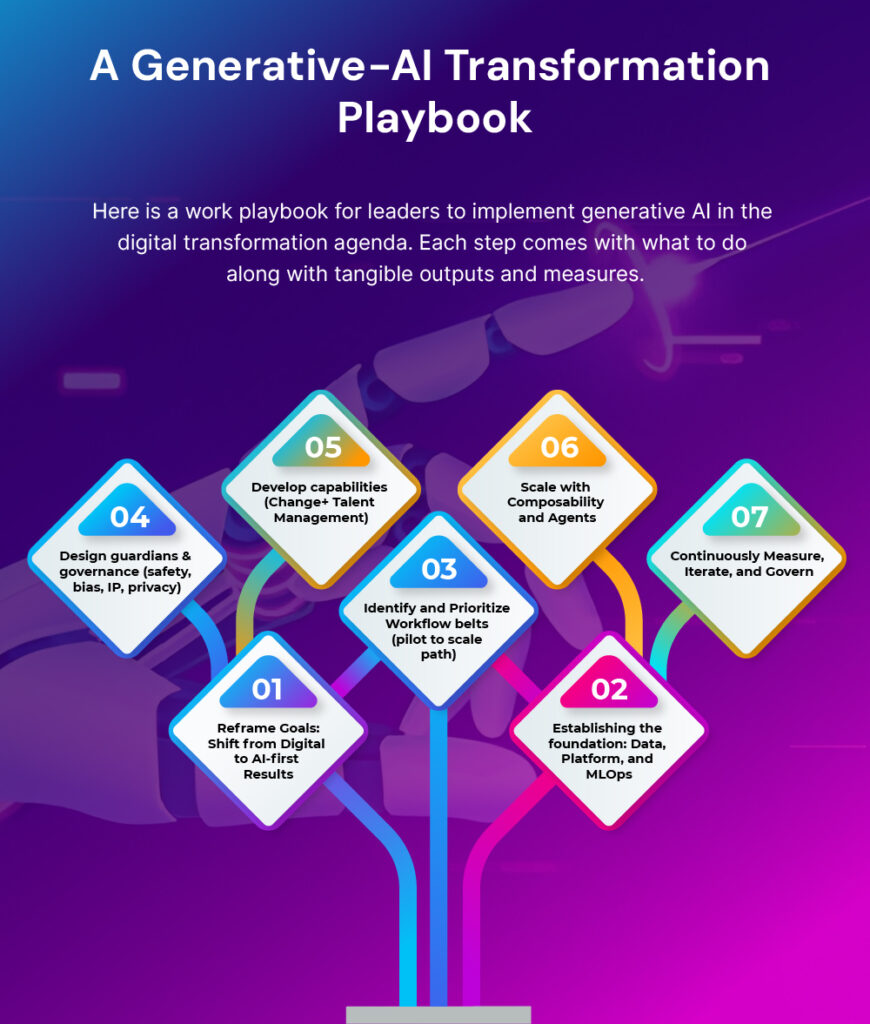
A Generative-AI Transformation Playbook
Here is a work playbook for leaders to implement generative AI in the digital transformation agenda. Each step comes with what to do along with tangible outputs and measures
- Reframe Goals: Shift from Digital to AI-first Results
- Stop questioning “How can GenAI decrease task time?” And question, “How might GenAI enable new services or new revenue?” Establish three business level applications of importance to executives: for instance, decrease claims cycle time by X%, enhance NPS in contact centers, or speed up product R&D timelines by Y%.
- Connect them to quantifiable KPIs. Forbes and other sources suggest rebranding digital transformation to a more executive business transformation focused on AI value creation.
Output: Highest value AI map (top 3 bets in ROI estimates)
2. Establishing the foundation: Data, Platform, and MLOps
Generative models require two things to be enterprise-ready: governed, clean data, and solid platform for training/inference.
Spend on:
a) data foundations (synthetic augmentation, catalogs, unifed schemas).
b) inference stacks that are cost-effective (cloud GPUs, edge), and
c) reproducible MLOps pipelines.
BCG and AWS have partner playbooks and competencies for selling GenAI workloads to leverage those patterns.
Output: Platform blueprint and cost model for inference/finetuning.
3. Identify and Prioritize Workflow belts (pilot to scale path)
Map end to end workflows and identify where Generative AI models will either:
- Automate a cognitive task like summarizing reports
- Augment a worker (draft suggestion), OR
- Orchestrate (agents for coordinating tasks).
Prioritize strategic value, feasibility, and compliance constraints. Some studies show that starting with customer facing or R&D workflows often yields rapid user adoption.
6-9 Pillot projects divided between quick wins and transformational bets.
4. Design guardians & governance (safety, bias, IP, privacy)
Generative models hallucinate and leak PII or IP. Implement governance upfront: model catalogs, explainability checks, red-team testing, and human in the loop (HITL) policy for high-risk decisions. Some major consulting firms prioritize governance as non-negotiable and create privacy by design and automated drift and hallucination monitoring.
Output: Playbook of governance (model risk levels, HITL thresholds, dashboards for monitoring).
5. Develop capabilities (Change+ Talent Management)
GenAI success demands collaboration between product managers, ML engineers, prompt engineers, and domain experts. Upskilling your teams with practical labs and real-world scenarios, partner programs (BCG, AWS, IBM training) speed this up. Plan change management for operational adoption too: integrate AI coaches into teams, tracking adoption metrics, and incentivize AI-driven innovation.
Output: Capability roadmap (roles, training plan, hiring pipeline)
6. Scale with Composability and Agents
After pilots have been validated, scaling by composing composable services: retrieval-augmented generation (RAG) APIs, domain adapters, and agent runtimes invoking internal services. Architect for reuse: index corporate knowledge once, make it safely available to numerous apps. BCG and AWS resources emphasize reusability and composability as the antidotes to pilot purgatory. Read More.
7. Continuously Measure, Iterate, and Govern
Monitor value (revenue lift, cost savings, cycle time), trust (error rates, hallucination incidents), and compliance. Establish an iterative cadence and check every quarter and refresh model version, prompts, and tooling from feedback. This is the agile backbone of a sustainable AI transformation.
Output: AI KPI dashboard and cadence playbook.
Two Industry Clusters: Health & Manufacturing (How the playbook is used)
Generative AI roadmaps are not theoretical as they need to be industry tuned. The following are tangible cross-cluster examples illustrating the playbook in use.
Healthcare Cluster: AI in Hospitals (Clinical Documentation, Care Coordination, and Clinical Decision Support)
Why GenAI is a Good Fit: Medical documentation and charting is labor intensive; generative technologies can distill notes, create discharge letter drafts, and pull coded information out of free text.
Public patient education personalization is another obvious win. IBM and healthcare pilots demonstrate that GenAI has the capability to minimize documentation burden and accelerate clinician workflows while enhancing patient engagement.
Playbook Application:
- Reframe: Try to decrease clinician time spent on documentation by X% and decrease coding errors.
- Foundation: Create a safe clinical data lake (de-identified PII), RAG indexes onto EHRs, and an inference environment HIPAA compliant.
- Pilot: Begin with physician reviewed note summarization and discharge summary drafts.
- Governance: Rigorous HITL review for any decision proximal output; explainability and audit trials required.
- Scale: Make summary APIs available for billing, quality, and patient facing portals.
- Impact: More efficient clinician time, accelerated billing cycles, and enhanced patient understanding but only under strict privacy and safety controls.
Manufacturer Cluster: AI in Factories (Knowlege Capture, SOP Automation, and Incident Response)
Why GenAI is a Good Fit:
Factories contain huge manuals, SOPs, and maintenance stories. Generative models can catalog institutional knowledge and offer instant answers, step by step instructions, and automated incident reports. GenAI can composite sensor histories into root cause stories for engineers.
Playbook Application:
- Reframe: Work to lower MTTR (mean time to repair) or accelerate SOP onboarding for new employees.
- Foundation: Construct a safe industrial data repository, include RAG over manuals and sensor parts.
- Pilot: Send an agent to read alarms, retrieve corresponding troubleshooting steps, and author incident reports for engineer examination.
- Governance: Provide IP security and tight offline/internet deployments for confidential blueprints.
- Scale: Integrate agentic workflows with procurement and spare parts systems to automate orders.
- Impact: Reduced troubleshooting time, fewer unexpected downtimes, and enhanced knowledge of retention.
Risks, Mitigation, & Policy Implications
Generative AI is bringing heightened risks that need to be actively mitigated:
- Hallucination & Safety
Models can make things up. Mitigation: RAG with source tagging, cautious prompts, HITL for high-risk outputs.
- Privacy & Data Leakage
Models can memorize and copy sensitive material. Mitigation: legal reviews, provenance tracking, and model documentation.
- Operational Fragility
Dependence on models with no fallbacks will shatter processes. Mitigation: human checkpoints, fallback rules, and runbooks.
- Regulatory Compliance
Industry regulations (finance, health) demand auditable choices and conservatism. Mitigation: conservatism in deployment for regulated areas, and compliance first designs.
Quick Checklist: 10 Tactical steps for leaders (First 120 days)
- Form an AI governance committee with business + IT + legal.
- Find 3 business KPIs which GenAI can impact and baseline them.
- Execute 2-3 sprint pilots (1-3 weeks) on high-priority workflows.
- Stand up secure RAG index for deeper corporate knowledge.
- Develop model governance taxonomy (low/medium/high risk).
- Budget for inference costs and identify GPU capacity in public cloud.
- Initiate a prompt engineering bootcamp for product and ops teams.
- Create legal and privacy guidelines for PIL, IP, and use of third-party models.
- Release a 90-day transparency memo for execs and auditors.
- Establish go/on-go gates for piloting scales.
Ultimate Decision: GenAI is an Accelerator and not a Shortcut Anymore
Generative AI opens mind blowing possibilities with faster R&D, automated knowledge work, and more advanced customer experiences. But it’s a catalyst, not a bypass. Organizations that approach GenAI as a strategic amplifier create data foundations, governance, and composable platforms, and linking projects to quantifiable business outcomes will succeed. Those that pursue features without architecture or controls risk expensive failures and regulatory drag.
Stick to the playbook: Reframe objectives, construct the platform, pilot intelligence, govern strictly, scale through composability, and instill measurement. Do that, and GenAI will be an integral part of your next digital transformation plan and not an isolated experiment but the basis for ongoing, AI-facilitated business change.

