

Topical authority and EEAT cannot be ignored if you are trying to build a website that will lead on Google search.
The reason these two are important is because these two show to Google that your website has trust, authority, expertise and experience, four qualities Google really treasures.
Even after so many years, it really breaks our hearts to see websites stuck in a rut of low ranking on Google because they are not giving topical authority and EEAT the time and effort they deserve.
If you are that business, this blog is your chance to become visible on Google so your customers can find you. Your ideal customers are waiting for you- they really are! But the problem is that Google is not able to rank you higher because of simple things that you are not doing.
Want to find your very own Google nirvana?
Read on to understand how to do it right now.
Understanding Topical Authority and EEAT for SEO
What is Topical Authority?
The perception that a website is a leading, reliable, and comprehensive source of information on a specific subject is deeply linked to the topical authority or TA of your site.
TA involves moving beyond individual keywords to owning an entire topic through deep and relevant content.
And this is where E-E-A-T comes in. Think of it as a framework that gets your site the much-coveted topical authority.
Why it matters for SEO?
Topical authority matters for SEO because it establishes your website as an expert resource in a specific niche. This leads to higher rankings and increased organic traffic.
This happens because as your site demonstrates deep and comprehensive knowledge through interconnected content around a pillar topic, it starts to signal expertise that readers can trust.
What is E-E-A-T or Experience Expertise Authority Trust in SEO?
To reiterate, E-E-A-T is not rocket science or a secret formula only available to the chosen; it is just a parameter or framework for Google to rank your site.
It stands for
- Experience
- Expertise
- Authoritativeness
- Trustworthiness
A little history here- E-E-A-T was just E-A-T before 2022. Google added Experience this year to reflect the growing importance of first-hand knowledge.
E-E-A-T helps your site build topical authority that’s actually a bunch of things like doing topic-based keyword research, chalking out topic clusters and building pillar content around them, and creating a web of informative and in-depth content around topics.
Look at it as a lens used by Google’s search quality evaluators to assess how helpful and trustworthy your content really is. This formula is extremely relevant for you if you are in the niches of health, money, and safety.
How do topical authority and EEAT work together for SEO?
Topical authority and EEAT work in tandem to boost SEO. While having topical authority demonstrates the depth of knowledge within a niche or topic, E-E-A-T provides the credibility framework that a search engine like Google uses to evaluate your site’s deep knowledge. Both, thus, are needed for higher rankings and increased user trust.
Google uses topical authority and EEAT to evaluate your overall site quality, especially in what’s called the “YMYL” (Your Money or Your Life) topics.
If you pass the Google E-E-A-T or Experience, expertise, authority, trust test, your site will see
- Increased visibility on high-intent search queries
- Enhanced credibility with your ideal target audience
- More backlinks and organic mentions
- And get a future-proofed site against algorithm shifts.
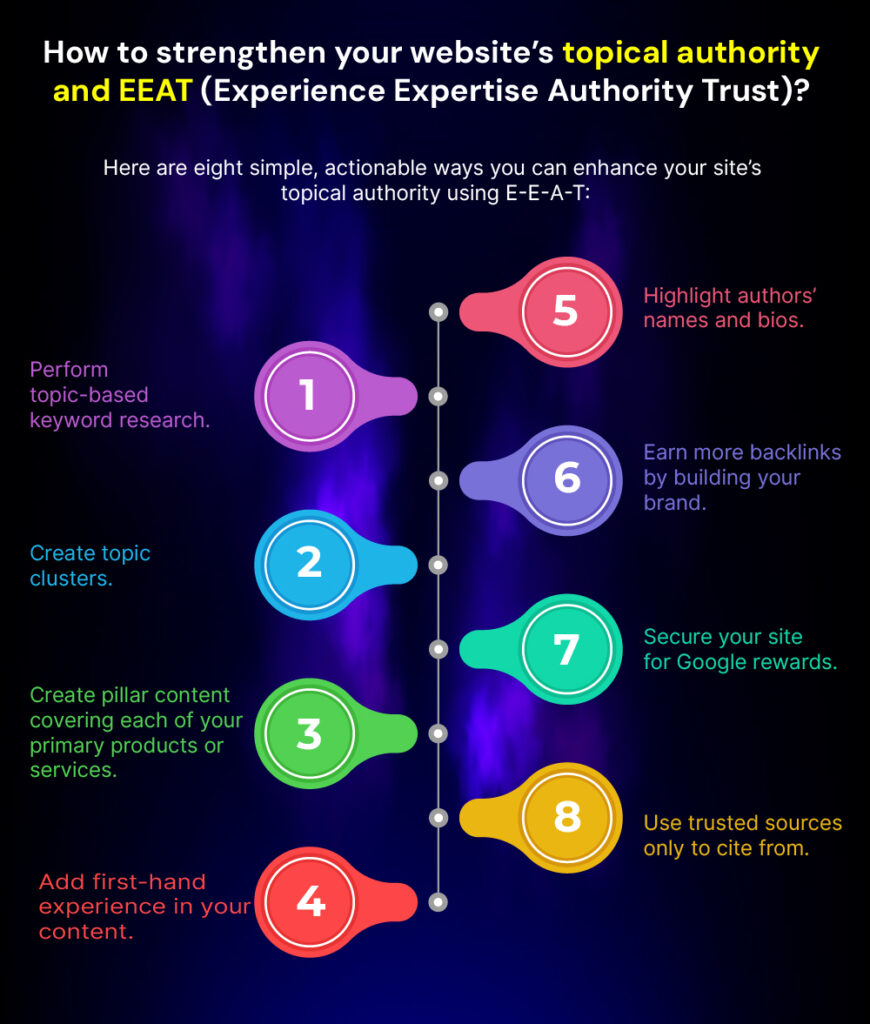
How to strengthen your website’s topical authority and EEAT (Experience Expertise Authority Trust)?
Here are eight simple, actionable ways you can enhance your site’s topical authority using E-E-A-T:
1). Perform topic-based keyword research that focuses on identifying and organizing keywords around a central theme rather than targeting individual topics.
An example is that you first identify your core topic or theme for your site, such as digital marketing. Then, break this broad keyword into subtopics like social media strategies, SEO strategies, email marketing, content marketing, etc.
And then carry out in-depth keyword research to find relevant long-tail keywords within your subtopics. For SEO strategies, you can find keywords like technical SEO, on-page SEO, SEO audit checklist, SEO backlinks, etc.
2). Create topic clusters.
You can build topical clusters by creating pillar pages and supporting content to build authority. Pillar content usually offers a broad overview of a core topic. It is in-depth and comprehensive, and you can add cluster content as related articles that dive into related topics.
Pillar and cluster content pieces are linked together to form a wide network of content that signals to Google that your site is an authoritative source on the subject of, say, digital marketing.
An example of a pillar topic is Ultimate guide to digital marketing and that of supportive content is How to write email copy that converts.
3). Create pillar content covering each of your primary products or services.
If your services are website design and digital marketing, you need to create pillar content for each of these.
4). Add first-hand experience in your content.
This means you need to add morecustomer reviews, personal anecdotes, case studies, and project snapshots with outcomes clearly mentioned across your content touchpoints.
5). Highlight authors’ names and bios.
Avoid publishing blogs without author names and bios. You should include the author’s qualifications, achievements, and/ or relevant experiences to build trust and authority. This applies more to blogs and is especially important for blogs on health, money, or legal issues.
6). Earn more backlinks by building your brand.
You need to work on earning more backlinks, getting your brand featured in respected publications, and getting more reviews from your actual users or customers.
7). Secure your site for Google rewards.
This is an absolute must-have. You can use HTTPS and make your website clean and easy to use. Your design should look professional and include pictures of your premises and team members and clear contact information, to build trust.
8). Use trusted sources only to cite from.
Make sure your cite data comes from high-ranking websites like recognized institutions. This will require you to link with intention.
This is how you can crack the E-E-A-T code
By showcasing your experience
You can show that you have experience in the topic you want to rank for by showing your experience. Let’s take an example here. If you are a skincare brand and you have a skincare product review blog that you want to rank on Google, all you have to do is include evidence that you have used that particular product.
Similarly, if you are a business that’s helping parents better their parenting skills, you have to write in the voice of someone who has raised kids themselves.
In simple words, just random tips and information in a dislocated voice and tone will not help your blog rank, even if you pile on paras after paras of information and stuff keywords in like mad, because Google is now prioritizing content drawn from real, lived experience, and not just some random, curated facts.
So, gear up and add more of
– product demos
– walkthroughs
– case studies
– tutorials
– and anecdotal insights to your online writing.
By showing your expertise
Expertise means that the person writing the blog has deep knowledge in the particular topic she is writing on.
This makes sense from a human angle as well- who would you go to for medical advice? To a doctor or a lawyer?
This is the reason Google prioritizes expertise and writer credentials, especially in the sensitive fields of legal advice, medical information, financial planning, or formal education.
What this means to you as a business is that you must show that you have domain expertise.
Being authoritative
Google takes a good look at your reputation online.
What it focuses on is whether-
- You have trusted sites linking back to your content?
- Do domain experts reference your work by quoting from it?
- Are your authors or writers have domain expertise? Are they known in their field?
If you want to build topical authority, you have to plan for the long haul. You have to create more high-worth content that is worth sharing by other experts, in other words.
Prioritising trustworthiness
This is the most important bit of the topical authority and EEAT formula.
How does Google know that your content can be trusted?
It does so by looking at these
- Factual accuracy
- Site security (https)
- Transparent author info
- And policies that respect users.
This means if your content is clickbaity, or if it’s plagiarised or lacks citations, it’s likely to be flagged “low in trust’ and not be ranked high by Google.
Finally…
If you work on your content to conform to topical authority and EEAT, it will win in the long run. Stick with our Google’s E-E-A-T guidelines, as they are not just a checklist but a mindset shift.
Always keep the reader in your mind while writing content and keep asking yourself whether you are being interesting and relevant to his needs and pain points. And whether your content is answering all the questions in his mind, without leaving loose ends that will force him to click off and go to your competitor’s page?
You have to be a friend and guide to your target customers, rather than a marketer running after bottomlines. This is the only way to build loyal and sticky customers who keep coming back to buy from you again and again. Because when real people trust your content, the search algorithms follow.
—————————————————————————————————
Frequently Asked Questions (FAQs)
Topical Authority is the ‘goal’: to be seen as the leading, comprehensive source on a specific topic. E-E-A-T is the ‘framework’ to achieve it, providing the principles (Experience, Expertise, Authoritativeness, Trustworthiness) that make your content credible and trustworthy to both users and Google.
Google added “Experience” in 2022 to prioritize first-hand, real-life knowledge. It means showing you’ve actually used a product, performed a task, or lived through a situation, moving beyond just theoretical expertise to build greater authenticity and trust.
While they are critical for “Your Money or Your Life” (YMYL) sites, such as those in finance, health, and law, these concepts benefit all websites, Google uses them as a general quality signal, and building trust always leads to better user engagement and loyalty, regardless of your niche.
Start by adding clear author bios that highlight relevant credentials and experience, especially for key articles. Use case studies, personal anecdotes, and original data to demonstrate first-hand experience, and always cite credible, authoritative sources to back up your claims.
Begin with topic-based keyword research. Identify a core theme for your site and break it down into subtopics. Then, create a “topic cluster” with a comprehensive pillar page on the main subject and interlink it with detailed articles covering each subtopic, signaling to Google that you are a comprehensive resource.

